

When EV chargers are installed in a commercial or apartment building, the natural assumption is that faster charging is better. Get vehicles charged quickly, keep chargers available, and make sure the electrical system isn’t overloaded. It’s a logical starting point — but it often leaves significant value on the table, and in many cases actively increases costs for the building operator, the local network, and ultimately electricity consumers as a whole.
How most EV charging systems operate today
Most EV charging systems are configured to deliver as much power as the available electrical capacity will allow. Load management systems are typically focused on this objective: use all available infrastructure capacity and ensure that the combined demand of all active chargers doesn’t exceed the electrical system’s physical limits.
This is a sound approach from a safety and infrastructure protection standpoint. In some situations, particularly where vehicles need to be fully charged within a short and predictable window, this approach is appropriate. But it treats every charging session as urgent — and in commercial building environments, most charging sessions are not urgent at all.
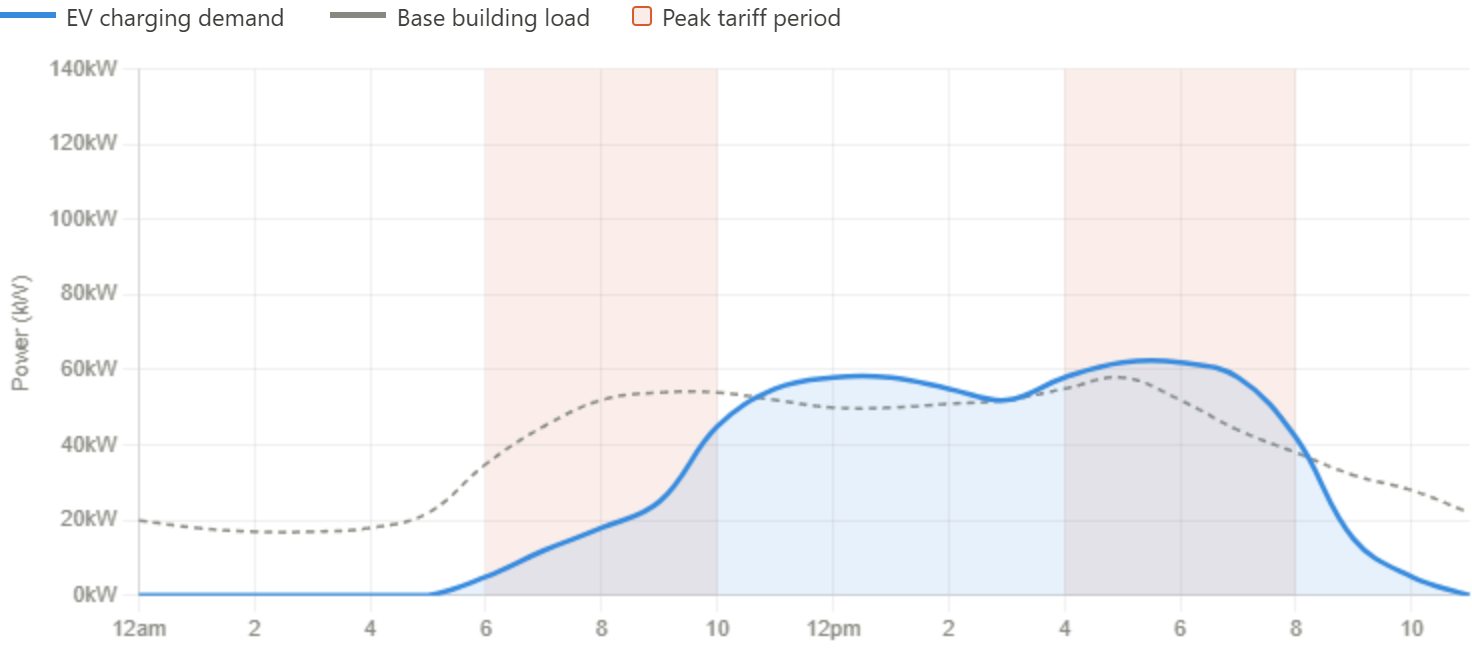
In a typical workplace or commercial car park, many vehicles arrive in the morning and do not leave until late afternoon or evening, or are parked at site overnight. An EV charging system operating at full available power will charge that vehicle as fast as it can, then sit idle — having consumed most of its energy during the first few hours after being plugged in, which in many locations coincides with the morning electricity peak period.

The hidden costs of always charging fast
When EV chargers consistently operate at full available power without regard for when that energy is consumed, several costs emerge — many visible on the electricity bill, some less obvious but just as real.
Electricity tariff costs. Many commercial electricity customers pay time-of-use tariffs — rates that vary depending on the time of day. Energy consumed during morning and evening peak periods typically costs significantly more per kilowatt-hour than energy consumed overnight or during off-peak daytime hours. An EV charging system that operates at high power during peak hours is consuming the most expensive electricity available, even when these vehicles would remain plugged in at lower tariff periods as well.
Peak demand charges. Many network operators apply a separate charge based not on how much energy a building consumes, but on the highest rate of power it draws during a defined period — often a monthly billing window. If EV charging adds a significant spike to building demand during a peak period, that spike can set the peak demand reading for the entire month, resulting in a substantially higher bill regardless of how efficiently the building operates at all other times. This charge can be one of the largest line items on a commercial electricity account, and it is highly sensitive to short periods of high demand.
Network capacity and infrastructure pressure. When large numbers of buildings draw heavily on the electricity network during the same peak periods, the cumulative effect is significant. Network operators must size their infrastructure — cables, transformers, substations — to handle the highest demand they will ever see. If that peak is driven in part by unmanaged EV charging, it contributes directly to the case for expensive network upgrades, the cost of which flows back to all electricity consumers through network tariffs.
What load shifting looks like in practice
Load shifting is the practice of deliberately adjusting when and how quickly EV charging happens — not to charge less in total, but to spread that charging more intelligently across the available time window.
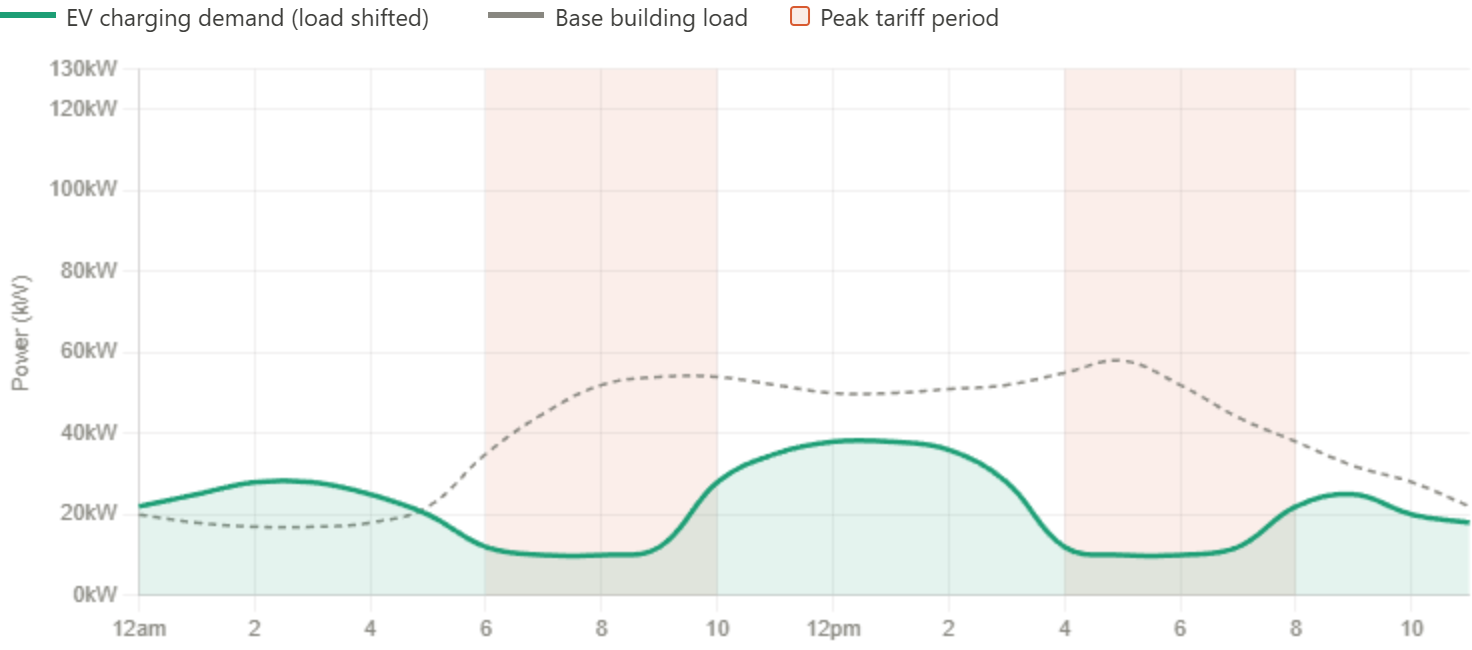
The key insight is this: if a vehicle will be parked for eight hours and only needs three hours of charging, there is no operational reason why all of that charging must happen in the first three hours. The same total energy can be delivered more slowly across a longer period — timed to avoid peak tariff windows, reduce demand spikes, and make better use of the electrical capacity that already exists.
In practical terms, a load shifting approach might look like this: chargers are allowed to operate at modest power levels from arrival through the morning peak period, then ramp up during the lower-cost midday window, moderate again during the evening peak, and resume through the night for vehicles that remain connected. Vehicles that genuinely need a fast charge — because of a short dwell time or a specific operational requirement — can still be prioritised. The system adjusts to actual need rather than defaulting to maximum power at all times.
This does not require vehicles to charge more slowly than needed. The goal is to match the rate of charging to what is actually required, given how long the vehicles will be connected.
The benefits, layer by layer
When EV charging demand is actively managed across the charging window rather than simply maximised within electrical limits, the benefits extend across several dimensions.
Lower electricity costs for the building operator. Shifting charging demand away from peak tariff periods directly reduces the cost of the energy consumed. Over a year of operation across multiple chargers, this can represent a material saving on the electricity account.
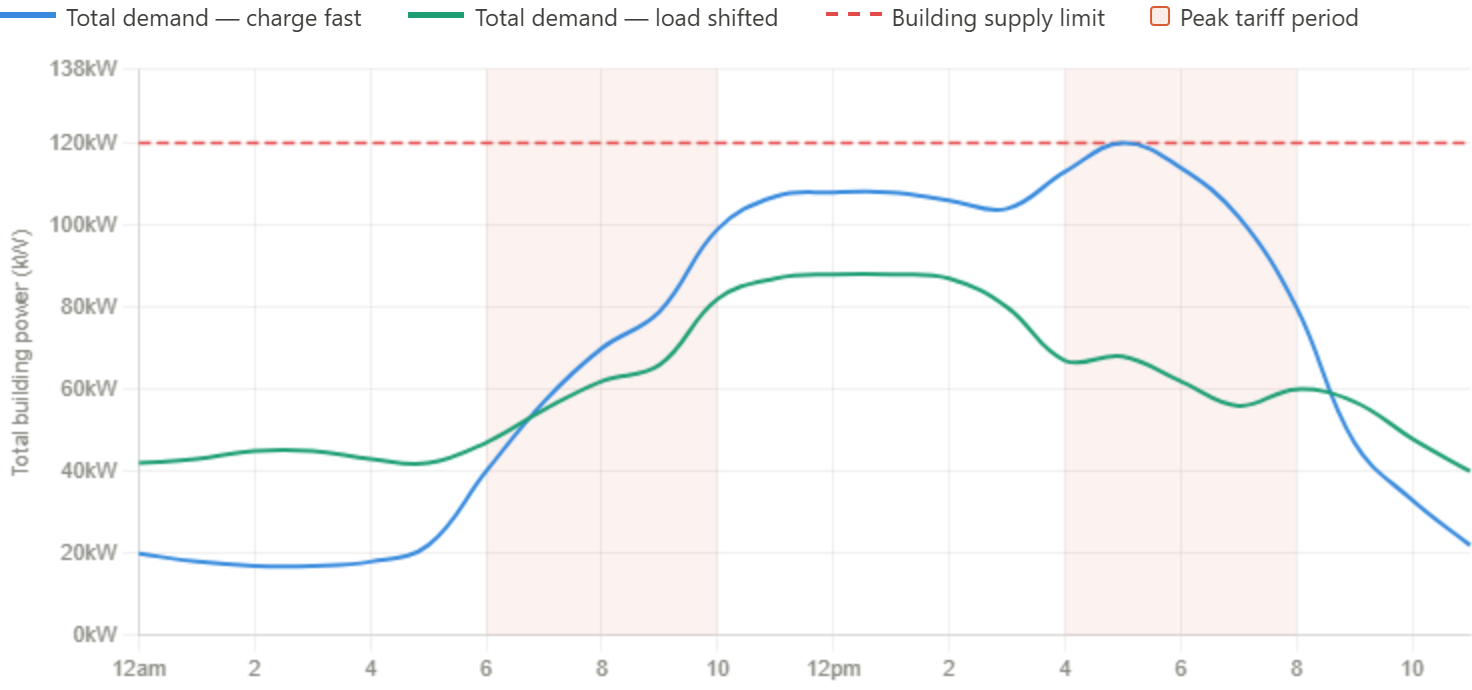
Reduced peak demand charges. By smoothing the EV charging demand profile and avoiding spikes during peak measurement periods, load shifting can significantly reduce — or in some cases eliminate — the contribution of EV charging to the building’s monthly peak demand reading. Given how disproportionately peak demand charges can affect a bill, this is often the most financially significant benefit available to building operators.
More charging from the same infrastructure. This is one of the most compelling arguments for load shifting, particularly for building operators planning to grow their EV charging provision. An electrical system that is heavily loaded during peak hours but lightly loaded overnight has unused capacity sitting idle for much of the day. By spreading charging across a longer window and making use of that off-peak headroom, a building can support significantly more charging sessions — and more vehicles — without any upgrade to the underlying electrical infrastructure. The same cables, switchboards, and supply connection can do more work, simply by doing it more evenly.
A more efficient local electricity network. When enough buildings manage their EV charging demand in this way, the aggregate effect on the local network benefits all electricity consumers. Peak demand across the network flattens, existing infrastructure operates more efficiently, and the pressure to build expensive new capacity is reduced.

Key takeaways
- Most EV charging systems maximise power delivery at all times, which is safe but not always efficient or cost-effective.
- Charging during peak tariff periods increases energy costs; contributing to peak demand readings can significantly increase network charges.
- Load shifting spreads charging across the available dwell time, reducing peak demand and moving energy consumption toward lower-cost periods.
- The same electrical infrastructure can support more EV charging when demand is distributed more evenly across the day.
- Benefits extend beyond the building — a flatter collective demand profile reduces pressure on local electricity networks and defers the need for costly infrastructure upgrades.
- Better Balancer enables load shifting through operator-controlled power allocation across charger groups and time periods.
A note on Better Balancer
Better Balancer supports load shifting by giving building operators direct control over how much power is allocated to each EV charger group, and what the total power ceiling for EV charging across the building is at any given time. Operators can set different power limits for different time periods — higher limits during off-peak hours, lower limits during peak tariff windows.
Explanatory note: time-of-use tariffs and peak demand charges
Time-of-use tariffs are electricity pricing structures where the cost per kilowatt-hour varies depending on the time of day. Energy consumed during designated peak periods — typically morning and evening hours on weekdays — costs more than energy consumed overnight or during off-peak daytime windows. Time-of-use pricing is designed to reflect the higher cost of generating and delivering electricity when network demand is at its greatest. Most commercial electricity customers in developed markets are already on some form of time-of-use tariff, whether they are aware of it or not.
Peak demand charges are a separate component of many commercial electricity bills. Rather than charging for the total volume of energy consumed, a peak demand charge is based on the highest rate of power drawn by the building during a defined measurement period — often a rolling monthly window, and sometimes measured only during designated peak hours. Because a single short period of very high demand can set the reading for the entire billing period, peak demand charges are particularly sensitive to spikes. A building that draws heavily for just thirty minutes during a peak measurement window may pay a significantly higher demand charge for that entire month, even if its energy consumption is otherwise modest. This is the charge that load shifting has the most direct and immediate impact on.
Related articles
Power, Phases, and EV Chargers: What Every Building Operator Should Know
A practical primer for building operators on single-phase and three-phase charging, switchboards, phase imbalance, and why smart load management matters.
Single-Phase and Three-Phase EV Chargers: How Each One Uses Your Building’s Power
How single-phase and three-phase chargers behave differently, why the weakest phase matters, and how phase rotation helps spread single-phase vehicle load.
The Hidden Electrical Challenge Facing Multi-Tenant Buildings — and How Facilities Managers Are Solving It
EV charging is becoming a tenant expectation, but multi-tenant buildings need an electrical coordination model that works across independent charger systems.