

EV chargers come in two main types — single-phase and three-phase. Both plug into your building’s electrical supply, but they interact with it in quite different ways. Understanding these differences helps you make better decisions about charger installations and gives you a clearer picture of what happens in your building’s electrical system when charging is underway.
For a broader look at how your building’s electrical supply is structured, see our earlier article: Power, Phases, and EV Chargers: What Every Building Operator Should Know.
Two types of charger, two ways of drawing power
Commercial buildings are supplied with three-phase electricity — three separate electrical supply lines, each carrying power independently. How a charger draws from those three phases depends on whether it is a single-phase or three-phase unit.
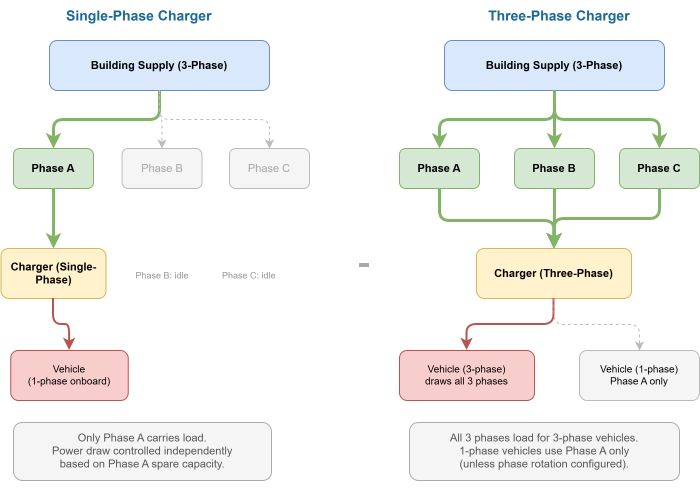
A single-phase charger connects to just one of those three phases. All of its power comes from that one line. The key point, however, is that a single-phase charger’s power draw can be controlled — its current limit can be turned up or down in response to how much spare capacity is available on its connected phase at any given moment.
A three-phase charger connects to all three phases simultaneously. When charging a three-phase vehicle, it draws power equally across all three phases at once. This is what allows three-phase chargers to deliver significantly more power — they are effectively using three lanes at the same time.
There is one important nuance here. A single-phase vehicle plugging into a three-phase charger will only ever draw power from Phase A — the first phase of the charger’s supply. The other two phases remain idle for that vehicle. The charger is three-phase capable, but the vehicle’s onboard electronics only make use of one phase, and that is always Phase A.
How load balancing works differently for each type
This is where the operational difference between the two charger types becomes most significant for building operators.
With single-phase chargers, each charger is its own independent connection to one specific phase. Because each charger sits on its own phase connection, its power draw can be managed based solely on what is happening on that phase. If Phase A has plenty of spare capacity, the chargers on Phase A can run at full power. If Phase C is under heavy load from other building equipment, the chargers on Phase C can be throttled back — without affecting chargers on Phases A or B at all. Each phase is managed independently.
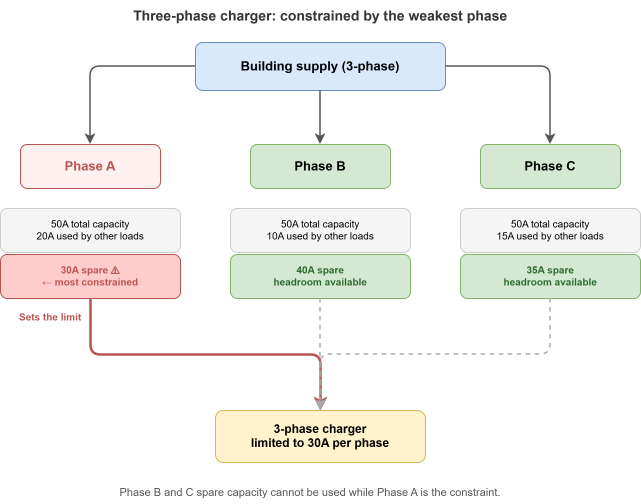
Three-phase chargers behave differently when charging three-phase vehicles. Because the vehicle draws equally across all three phases, the charger must operate at the same current level on all three phases simultaneously. It cannot draw more from Phase B than Phase A — the current on all three phases must always be equal.
This creates a meaningful constraint. If Phase A has 30 amps of spare capacity, Phase B has 50 amps, and Phase C has 40 amps, a three-phase charger can only run at the limit of the most constrained phase — in this case, 30 amps per phase. The additional headroom available on Phases B and C cannot be accessed. That spare capacity on the other phases simply goes unused while the charger is limited by Phase A.
This is not a flaw in three-phase chargers — it is simply how the physics of balanced three-phase charging works. But it is worth understanding, because in a building where phase loads are naturally uneven, as most commercial buildings are, a three-phase charger may not always be able to take full advantage of the available power in the system.
Each type has its place
Neither charger type is universally better than the other. They serve different needs, and most well-considered installations can include both.
Three-phase chargers are essential when users need faster charging. A vehicle with a three-phase onboard charger can charge at 11 kW or 22 kW, compared to a maximum of around 7 kW on a single-phase supply. For drivers with longer daily distances or limited charging schedules, this difference is significant.
Single-phase chargers offer finer control over how your building’s power is used. Because each charger sits independently on one phase, a load management system can precisely allocate available capacity across phases, maximising the amount of useful charging that can happen within the building’s electrical limits. In buildings where phase loads are uneven — which is most buildings — this flexibility can mean more vehicles charging at once.
Explanatory note: phase rotation in three-phase chargers
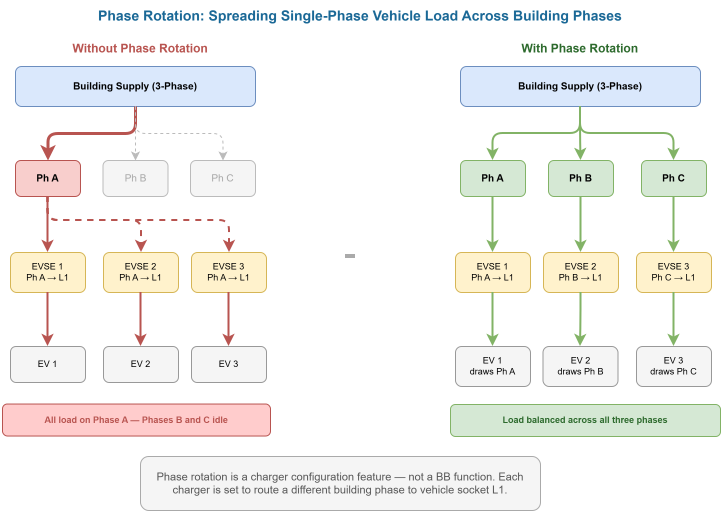
As noted above, single-phase vehicles always draw power from Phase A of the charger’s connector. In an installation with multiple three-phase chargers, this means that if all of those chargers happen to be serving single-phase vehicles at the same time, the entire charging load falls on Phase A of the building supply — while Phases B and C sit largely idle.
Many three-phase chargers include a feature called phase rotation to address this. Phase rotation allows the charger to reassign which building supply phase is routed to the vehicle socket’s Phase A connection. In practical terms, one charger might be configured so that its vehicle socket’s Phase A is fed from building Phase A, a second charger routes building Phase B to vehicle Phase A, and a third routes building Phase C to vehicle Phase A. Single-phase vehicles using each of these chargers will draw from different building phases, spreading the load across the supply rather than concentrating it on one phase.
This is a configuration setting within the charger itself — it is not a Better Balancer function. However, when phase rotation is set up correctly across a multi-charger installation, it supports more balanced phase loading across the building supply, which in turn helps load management systems like Better Balancer operate more effectively.
Key takeaways
- Single-phase chargers draw from one phase only, and that draw can be independently controlled based on that phase’s available capacity.
- Three-phase chargers serving three-phase vehicles draw equally across all three phases, limited by the most constrained phase.
- Spare capacity on less-loaded phases cannot be accessed by a three-phase charger if another phase is more constrained.
- Both charger types have their place — three-phase for speed, single-phase for flexible phase-by-phase load management.
- Phase rotation is a charger feature that spreads single-phase vehicle load across all three building phases in multi-charger installations.
A note on Better Balancer
Better Balancer does not directly control individual EV chargers. Instead, it monitors the available power capacity at each level of the building’s electrical system and sends maximum load limit signals to groups of chargers. Each charger group’s own Dynamic Load Balancing system receives those signals and manages its individual chargers to stay within the limits provided. This distinction matters: Better Balancer sets the boundary, and the charger system manages within it.
Related articles
Power, Phases, and EV Chargers: What Every Building Operator Should Know
A practical primer for building operators on single-phase and three-phase charging, switchboards, phase imbalance, and why smart load management matters.
Smarter EV Charging: The Case for Charging Slower and Longer
Why always charging at full available power can increase costs, peak demand, and network pressure, and how load shifting changes the equation.
How Better Balancer Gives Every Charger Operator Visibility and Control — Automatically
How LMS Sharing and software integrations give charger operators real-time visibility of their power limits while the building owner retains control of supply limits.