

If you manage a commercial building, EV chargers are either already part of your life or they soon will be. But before you can manage them confidently, it helps to understand a little about how electricity actually moves through your building — and why adding chargers isn’t quite as simple as plugging in another appliance.
Not all EVs charge the same way
Nearly every electric vehicle has a built-in AC charger — a piece of electronics that converts the AC electricity from your building’s supply into the DC electricity the battery stores. What varies between vehicles is how powerful that onboard charger is, and whether it’s designed to use single-phase or three-phase electricity.
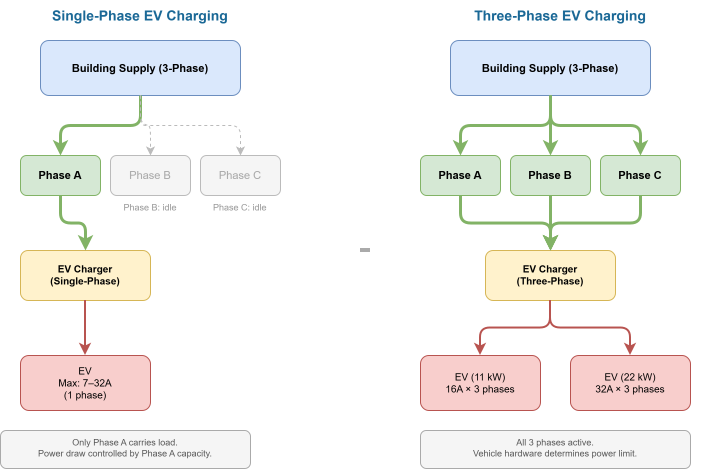
Think of phases as lanes on a motorway. A single-phase charger only uses one lane. A three-phase charger uses three lanes simultaneously, moving more energy in the same amount of time.
A typical single-phase EV charger might draw up to 32 amps. Some vehicles, however, have onboard chargers limited to less than that — say 16 amps — regardless of what the charger on the wall can supply. The vehicle itself is the limiting factor.
Three-phase capable vehicles can draw power across all three phases. Depending on the vehicle’s onboard hardware, this might be 16 amps per phase or 32 amps per phase — corresponding to approximately 11 kW or 22 kW of charging power respectively.
Why does this matter for you as a building operator? Because the types of charger installed and the wiring behind them influence the electricity demand across phases. And more importantly, every amp that flows into a car comes from somewhere in your building’s electrical system.
Your building’s electrical supply: the root system
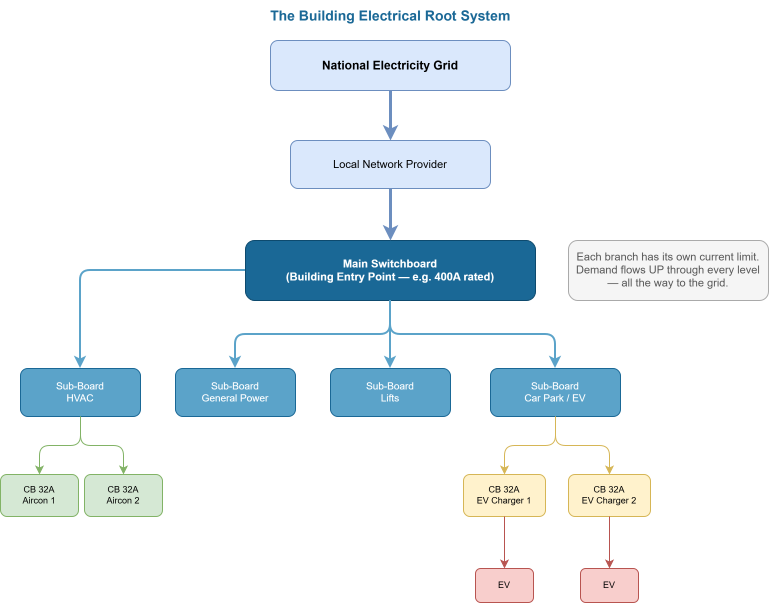
Almost every commercial building is supplied with three-phase electricity from the local network. That supply enters the building at a main switchboard — the trunk of the tree, if you like — and from there, power is distributed outward through circuit breakers and sub-switchboards, branching further and further until it reaches every socket, light fitting, air conditioning unit, lift, and EV charger in the building.
This structure works like the root system of a tree. The main switchboard can supply direct power consumers via circuit breakers and can also supply sub-switchboards, which are like the lateral roots branching off from it. Individual circuit breakers can also be the smaller root tips, each delivering power to a specific load.
Every point in this root system has a physical capacity limit. The main switchboard might be rated to supply 400 amps across all three phases. A sub-switchboard in your car park might be rated to 100 amps. An individual EV charger circuit might be protected by a 32-amp breaker. These aren’t arbitrary numbers — they reflect the physical capability of the cables, busbars, and switchgear at each point.
Everything draws from the same pool
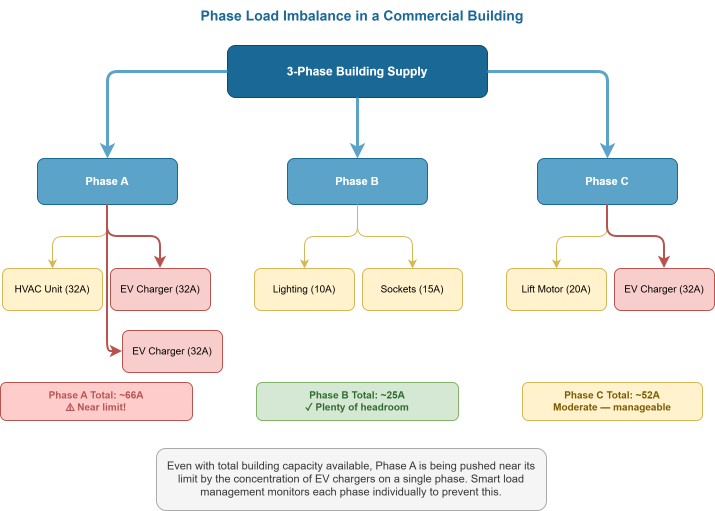
Here’s where it gets important for day-to-day operations. Your building’s electrical loads — heating and cooling systems, lifts, lighting, general power — don’t all draw evenly from all three phases. Some equipment is three-phase. A lot of it is single-phase, connected to whichever phase was available when it was wired in.
The result is that at any given time, the three phases of your building’s supply may be carrying quite different loads. One phase might be heavily loaded while another has plenty of headroom. This imbalance is normal, and your electrical system is designed to handle a reasonable degree of it. But it’s important to be aware of, because EV chargers add to this picture — potentially significantly.
When multiple single-phase chargers are all connected to the same phase, or when a large three-phase charger is added to an already-loaded circuit, the demand on that part of the electrical root system increases. Every load at the branch level adds up through the parent sub-switchboards, through the main switchboard, and ultimately contributes to the total demand seen by the electricity network supplying your building.
What happens when limits are exceeded
Circuit breakers exist to protect the physical wiring and equipment from being overloaded. If the current flowing through a circuit exceeds the breaker’s rated limit, it trips — automatically disconnecting that circuit.
In practice, this means that if EV charger demand pushes a sub-switchboard beyond its capacity, that breaker opens. Everything connected through it goes off. That might be a row of chargers, but it could also be lighting circuits, HVAC equipment, or other building services connected through the same board.
Resetting a tripped breaker isn’t always straightforward. Depending on your building’s procedures and the nature of the trip, it may require a licensed electrician to attend, identify the cause, confirm it’s safe to restore, and manually reset the breaker. That’s downtime, cost, and disruption — all of which are avoidable with proper management.
Where smart load management fits in
This is the problem that EV load management systems are designed to solve. Rather than letting chargers draw power freely and risk tripping a breaker, a system like Better Balancer continuously monitors the electrical demand at each level of your building’s root system — from individual charger circuits up through sub-switchboards to the main supply.
By measuring available capacity at every branch point in real time, it can instruct chargers to draw only as much power as the system can safely provide at that moment. When other building loads are high, chargers are instructed to use less. When capacity opens up, charging speeds increase. The vehicles still charge — they just do so in a way that keeps the whole electrical system balanced within its limits.
For building operators, the practical outcome is straightforward: EVs get charged, breakers don’t trip, and your electrician doesn’t get called out to fix unnecessary problems.
Key takeaways
- EVs have onboard chargers with fixed power limits and single or multiphase design — vehicles, not just the wall chargers, determine the maximum power drawn per phase.
- Commercial buildings distribute electricity through a hierarchy of switchboards and circuit breakers, each with its own capacity limit.
- All building loads — including EV chargers — draw from the same electrical supply, and demand at any point adds up through the entire system.
- Exceeding electrical limits trips circuit breakers, causing outages and often requiring an electrician to restore.
- Smart load management keeps EV charging within safe limits automatically, without manual intervention.
Related articles
Single-Phase and Three-Phase EV Chargers: How Each One Uses Your Building’s Power
How single-phase and three-phase chargers behave differently, why the weakest phase matters, and how phase rotation helps spread single-phase vehicle load.
Smarter EV Charging: The Case for Charging Slower and Longer
Why always charging at full available power can increase costs, peak demand, and network pressure, and how load shifting changes the equation.
How Better Balancer Gives Every Charger Operator Visibility and Control — Automatically
How LMS Sharing and software integrations give charger operators real-time visibility of their power limits while the building owner retains control of supply limits.